Technical Review: SLPI-Loaded Liposomes Targeting Kupffer Cells Modulate Macrophage Polarization and Mitigate Radiation-Induced Liver Damage

Authors: Nan Yuan, Xiaodong Sun, Gang Zhao, Shihong Li, Qi Zhang, Jianping Cao, and Yang Jiao
Affiliations: Soochow University, Suzhou, China
Background Introduction
Radiation-induced liver damage (RILD) is a severe and dose-limiting complication of radiotherapy for abdominal and thoracic malignancies. The pathogenesis of RILD involves a complex inflammatory response largely driven by Kupffer cells (KCs), which are the liver's resident macrophages. Upon exposure to ionizing radiation, these cells rapidly activate and secrete pro-inflammatory cytokines. This process exacerbates tissue injury and promotes structural damage. However, the exact molecular mechanisms governing the phenotypic shift of KCs during radiation stress have remained incompletely characterized.
By investigating the transcriptomic remodeling of hepatic immune cells, this paper identifies a critical molecular target driving this inflammation and evaluates a nanoparticle-based intervention to mitigate radiation toxicity.

Materials and Methodology
Initial studies utilized 10×Genomics single-cell RNA sequencing (scRNA-seq) on liver tissues from C57BL/6J mice exposed to 30 Gy whole-liver X-ray irradiation to map the immune landscape. In vitro assays involved establishing stable SLPI-overexpressing and knockdown RAW264.7 macrophage cell lines. These macrophages were then co-cultured with primary hepatocytes to assess radiation-induced crosstalk, cytokine secretion, and cellular apoptosis. For in vivo validation, the researchers utilized gadolinium chloride (GdCl3) for targeted KC depletion and an M1 macrophage adoptive transfer model to establish the cellular drivers of the disease. To test the therapeutic intervention, small interfering RNA (siSLPI)-loaded liposomes were synthesized using microfluidics. These functionalized liposomes, alongside an AAV8-shSLPI vector control, were administered intravenously to irradiated mice. The therapeutic efficacy of targeted SLPI inhibition was then evaluated through liver histopathology, enzyme-linked immunosorbent assays (ELISA), and serum biochemistry.
Results
scRNA-Seq Reveals M1 KC Expansion in RILD
10×Genomics scRNA-seq with pseudotime analysis of irradiated versus control livers revealed a marked shift of KCs toward an M1-like pro-inflammatory phenotype, with SLPI and HMOX1 identified as key differentially expressed genes driving KC functional reprogramming. Flow cytometry confirmed a significant increase in M1-polarized KCs following 30 Gy exposure, while serum ALT and AST levels rose progressively from day 1 (67.69 and 232.3 U/L, respectively) to day 14 (202.1 and 310.5 U/L) post-irradiation. These findings establish single-cell resolution evidence for a radiation-driven M1 KC axis, providing an unambiguous cellular and molecular target for downstream mechanistic and therapeutic investigation.
KC Depletion and Adoptive Transfer Confirm Pathogenic Role
GdCl₃-mediated KC depletion significantly attenuated radiation-induced ALT/AST elevation, cytokine upregulation (TNF-α, IL-6, IL-1β), and histopathological damage, while multicolor immunofluorescence showed that M1—but not M2—KCs exhibited pronounced radiation-induced DNA damage. Conversely, adoptive transfer of in vitro-polarized M1 macrophages into irradiated mice significantly exacerbated liver injury markers and pro-inflammatory cytokine expression. This bidirectional experimental design causally links M1-polarized KCs to RILD progression and rules out alternative macrophage subtypes as primary pathogenic drivers.

SLPI Drives Radiation-Induced M1 Polarization
SLPI mRNA expression in RAW264.7 macrophages tracked closely with the M1/M2 ratio across radiation doses (0–20 Gy), peaking at 10 Gy. Stable SLPI knockdown markedly suppressed TNF-α, IL-6, and IL-1β protein expression after irradiation, while SLPI overexpression upregulated M1 signature markers, confirming a direct regulatory relationship. These gain- and loss-of-function results position SLPI as a central molecular switch for radiation-induced KC polarization, distinguishing it from a mere correlative biomarker and validating it as an actionable therapeutic target.
SLPI-Mediated KC–Hepatocyte Crosstalk Amplifies Injury
In the Transwell co-culture system, co-culture with irradiated RAW264.7 cells increased primary hepatocyte apoptosis by 3.3–7.0% relative to irradiated hepatocytes alone, accompanied by significantly elevated IL-1β, IL-6, and TNF-α levels. SLPI silencing in co-cultured macrophages reduced hepatocyte apoptosis by approximately 15% at both 5 and 10 Gy and correspondingly decreased inflammatory cytokine secretion. These results demonstrate that SLPI-driven M1 KC polarization is not a bystander phenomenon—it actively amplifies paracrine hepatocyte damage, underscoring the pathophysiological relevance of the SLPI–KC–hepatocyte signaling axis.
Liposomal siSLPI Delivery Provides In Vivo Therapeutic Protection
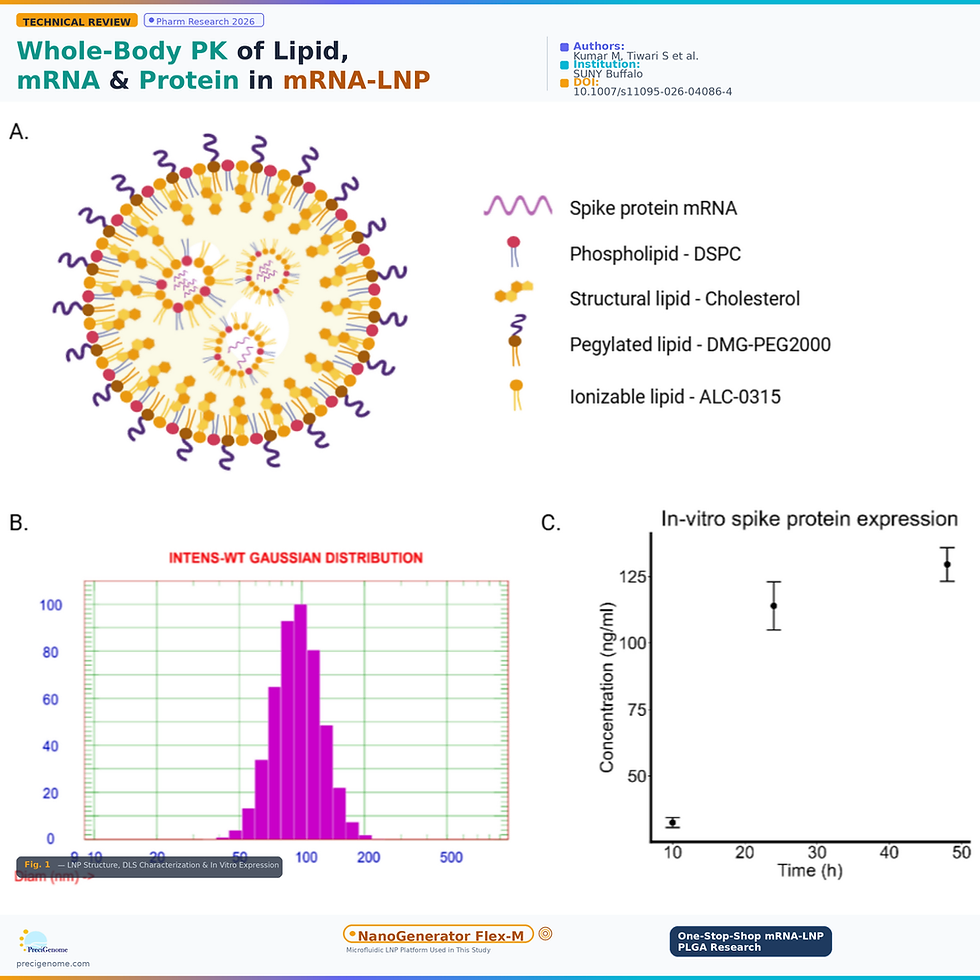
siSLPI-loaded LNPs exhibited uniform spherical morphology (~78 nm), a high siRNA encapsulation efficiency of 90%, complete cellular internalization by RAW264.7 cells within 1 h, and peak hepatic accumulation at 4 h post-IV injection with no detectable cytotoxicity. In irradiated mice, siSLPI-liposome treatment reduced serum ALT to 45.21 U/L and AST to 213.4 U/L, partially preserved hepatic architecture, and significantly lowered hepatic IL-1β, IL-6, and TNF-α levels (p < 0.05 for each). Comparable protective effects were independently confirmed in the AAV8-shSLPI model (ALT 22.12 U/L; AST 122.5 U/L), with no histopathological abnormalities in off-target organs. The convergent efficacy across two independent SLPI knockdown platforms provides robust translational evidence for the liposomal strategy.
Conclusion
Yuan and colleagues successfully demonstrated that SLPI-mediated functional reprogramming of Kupffer cells is a core driver of radiation-induced liver damage, and that suppressing this pathway offers profound hepatoprotection. The SLPI–KC axis therefore represents a promising druggable target for future study of model-to-clinic translation.
This paper utilized the PreciGenome NanoGenerator Flex-M for liposomal synthesis. Microfluidic mixing offers a controlled environment for producing highly uniform liposomes, which in turn ensures more efficient drug delivery. The same principles can apply to similar structures such as lipid nanoparticles (LNPs), making microfluidic mixers like the Flex-M highly versatile instruments.
For further details, check out the link to the article here:


I was looking for something quick to play and eggy car turned out to be a fun choice. The later sections definitely require more careful driving.